
The AI Governance Window in Q3 2026: Narrowing by a Thin Margin
Q3 2026 produced the strongest opening record the tracker has logged, and its heaviest evidence of lost control. The window is still narrowing, but only just.
Q3 2026 produced the strongest opening record the tracker has logged, and its heaviest evidence of lost control. The window is still narrowing, but only just.

Corporations have had 140 years of infrastructure that has made them durable over time. Workers have almost none. This essay argues the asymmetry is architectural before it is political–and that AI is forcing the choice between closing it and making it permanent.
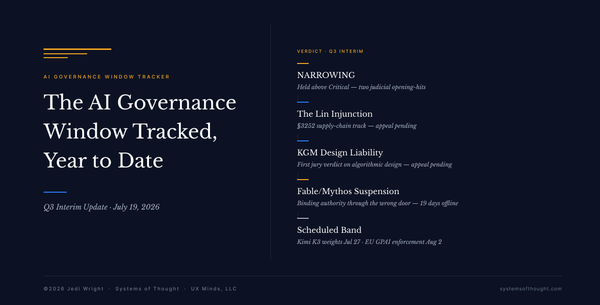
The AI governance tracker moved from Critical to Narrowing between May and June. That's not a sign things got better. It's a sign the instrument was wrong, and I rebuilt it. Seven months of AI governance: preemption, Fable/Mythos, WAICO, Kimi K3, told through a YTD diagram.
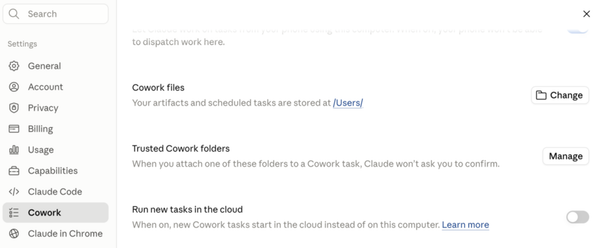
Anthropic quietly switched Claude Cowork from local to remote execution: by default, mid-rollout, without an opt-in prompt. Here's what that means for researchers, practitioners, and anyone running provenance-sensitive workflows.
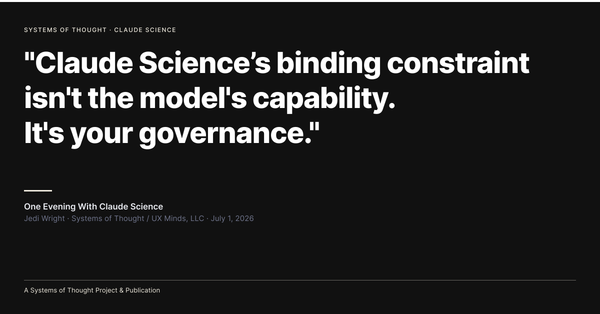
A first-evening, no-hype account of Claude Science from inside a research program built on a discipline of provenance, with real gains and real caveats.
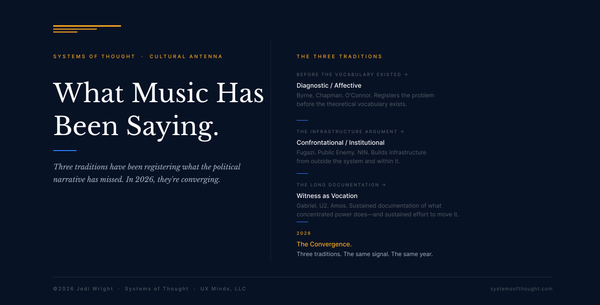
Since I can remember, I've watched a specific set of artists register what the political narrative missed. This is what that record sounds like and what it means that it's converging in 2026.
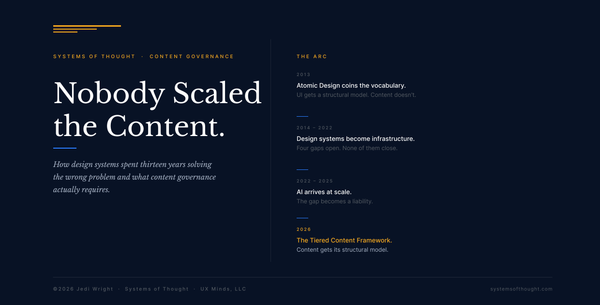
Design systems spent thirteen years solving the interface problem. The content layer never got its equivalent model—and for most of that time, the cost was manageable. Then AI arrived. This is the argument for why the gap existed, why it persisted, and why closing it became critical.
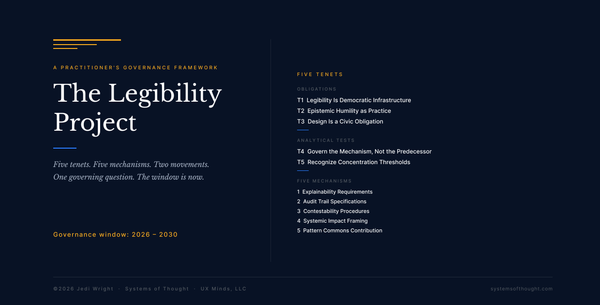
The infrastructure of democratic renewal is built in specifications and design systems—by practitioners making decisions that will preserve or foreclose democratic legibility at scale. Five tenets. Five mechanisms. One question: are you making the system legible, or the illegibility more elegant?
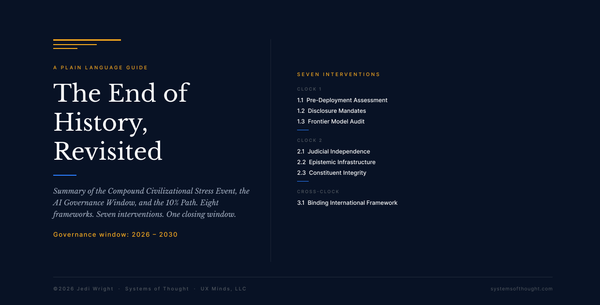
A plain language guide to the compound civilizational stress event now underway, the seven binding interventions that could still close the AI governance gap, and why the window to act is 2026–2030.
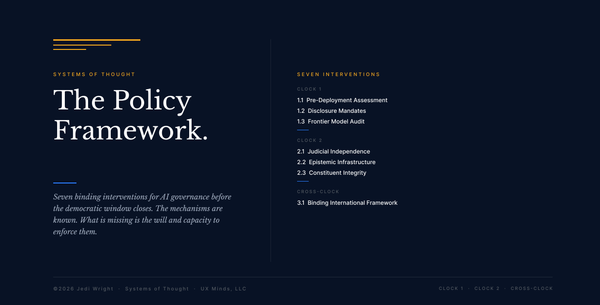
The binding-authority gap is widening. The mechanisms are known. What is missing is not knowledge but political will, and the window is measured in years, not decades.
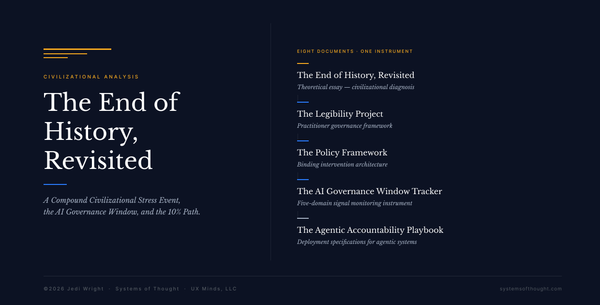
A Compound Civilizational Stress Event, the AI Governance Window, and the 10% Path. The full article with footnotes runs approximately 17,000 words.
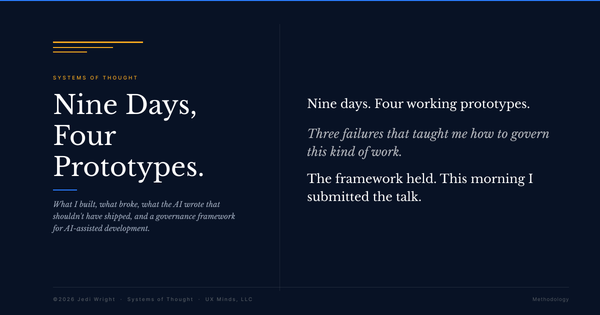
Four local-first apps. Nine days. Three bugs the AI wrote confidently, and I accepted. The case study and governance framework—what breaks when you vibe-code local-first, and what prevents it.